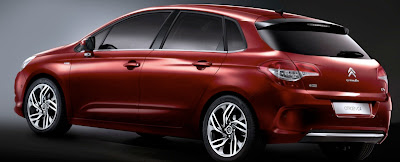
2005 Citroen C4 Overview with prices
2011 citroen c4 interior car prices with wallpapers


Prepare for impending teasing over the next few days as Citroën has released the first in a likely series of preview images of the third member in its distinctive line of DS models, the DS5, which will receive its world premiere on 18 April at the Shanghai International Motor Show.Aside from the image pictured above, the French carmaker is keeping mum on all the details simply stating that the

There were 41 candidates eligible for the European 2011 Car of the Year (COTY) award, with quite a few big names being mentioned, such as the Audi A7 Sportback and A8, BMW 5-Series and X3, Jaguar XJ and Mercedes Benz CLS. This week, the list was narrowed down to just seven finalists and, as in previous years, some of them weren't really expected to make it this far.
Our summary presents the remaining candidates in alphabetical order, with the winner set to be announced on November 29. We'd really like to know which of the seven cars would get your vote, though, so comment away below.

The Citro�n DS (also known as D�esse, or Goddess, after the punning initials in French) was an automobile produced by the French manufacturer Citro�n between 1955 and 1975. Citro�n sold nearly 1.5 million D-series during its 20 years of production.The DS is well-known for its futuristic, aerodynamic body design, and for its innovative technology (including its hydropneumatic self-leveling suspension system).
Technical innovations
Hydraulic system
The hydraulic system of the DS 19 was a revolution. Previously hydraulics had been restricted to use in brakes and power steering; the DS used them for the suspension, clutch and transmission. The later ID19 had manual steering and a simplified power braking system.
Suspension
At a time when few passenger vehicles had caught up with the four-wheel independent suspension of the Traction Avant, the application of the hydraulic system to the car's suspension system to provide true self-levelling was a stunning move. This application - 'hydropneumatic suspension' - was pioneered the year before on the rear of the top of range Traction Avant 15CV-H.
Each wheel was connected not to a spring, but to a hydraulic suspension unit consisting of:
* a sphere of about 12 cm in diameter containing pressurised nitrogen
* a cylinder containing hydraulic fluid screwed to the suspension sphere
* a piston inside the cylinder connected by levers to the suspension itself
* a damper valve between the piston and the sphere
A membrane in the sphere prevented the nitrogen from escaping. The motion of the wheels translated to a motion of the piston, which acted on the oil in the nitrogen cushion and provided the spring effect. The damper valve took place of the shock absorber in conventional suspensions.
The hydraulic cylinder was fed with hydraulic fluid from the main pressure reservoir via a height corrector, a valve controlled by the mid-position of the anti-roll bar connected to the axle. If the suspension was too low, the height corrector introduced high-pressure fluid. If it was too high, it released fluid back to the fluid reservoir.
A control in the cabin allowed the driver to select one of five heights:
- normal riding height.
- two slightly higher riding heights, for poor terrain.
- two extreme positions for changing wheels.
The DS did not have a jack for lifting the car off the ground. Instead, the hydraulic system enabled wheel changes with the aid of a simple adjustable stand.
Source and reserve of pressure
The central part of the hydraulic system was the high pressure reservoir, which maintained a pressure of between 130 and 150 bar in two accumulators. These accumulators were very similar in construction to the suspension spheres. One was dedicated to the brakes, and the other ran the other hydraulic systems. Thus in case of a hydraulic failure (a surprisingly infrequent occurrence), the first indication would be that the steering became heavy, followed by the gearbox not working; only later would the brakes fail.
Hydraulic fluid
The original hydropneumatic system used a vegetable oil (LHV or liquide hydraulique v�g�tale) similar to that used in other cars at the time. Very soon, Citro�n changed to using a synthetic fluid (LHS or liquide hydraulique synth�tique). Both of these had the disadvantage that they are hygroscopic, as is the case with most brake fluids. Disuse allows water to enter the hydraulic components causing deterioration and expensive maintenance work. The difficulty with hygroscopic hydraulic fluid was exacerbated in the DS/ID due to the extreme rise and fall in the fluid level in the reservoir, which went from nearly full to nearly empty when the suspension "got up" and the 6 accumulators in the system filled with fluid. With every "inhalation" of fresh moisture- (and dust-) laden air, the fluid absorbed more water. In August 1967, Citro�n introduced a new mineral oil-based fluid LHM, or liquide hydraulique min�rale. This fluid was much less aggressive on the system and it remains in use to the present day.
Gearbox and clutch
The mechanical aspects of the gearbox and clutch were completely conventional and the same elements were used in the ID 19.
The gear change control consisted of:
* Hydraulic gear selector.
* Clutch control. This was the most complicated part. The speed of engagement of the clutch was controlled by:
* A centrifugal regulator, sensing engine rpm and driven off the camshaft by a belt
* The position of the butterfly valve in the carburettor (i.e. the position of the accelerator)
* The brake circuit: when the brake was pressed, the engine idle speed dropped to a rpm below the clutch engagement speed, thus preventing friction while stopped in gear at traffic lights. When the brake was released, the idle speed increased to the clutch dragging speed. The car would then "creep" much like automatic transmission cars. This drop in idle throttle position also caused the car to have more engine drag when the brakes were applied even before the car slowed to the idle speed in gear, preventing the engine from "pulling" against the brakes.
DS in the US
While the DS was a hit in Europe, it seemed rather odd in the United States. Ostensibly a luxurious car, it did not have the basic features that buyers of that era expected to find on such a vehicle - fully automatic transmission, air conditioning, power windows and a reasonably powerful engine. The DS price point was similar to the contemporary Cadillac luxury car. Also, people at the time wanted only the newest models, which changed every year, like fashion, yet the DS appeared vaguely derivative of the 1950 Hudson Hornet step-down design.
Outdated US legislation also banned one of the car's more advanced features, aerodynamic headlamps, now common in US automobiles. Ultimately, 38,000 units were sold. The first year of the aerodynamic glass over the DS' headlights along with driving lights turned by the steering, was also the first year these features were outlawed in the US.
Design variations
The DS always maintained its size and shape, with easily removable, unstressed body panels, but certain design changes did occur.
A station wagon version was introduced in 1958. It was known by various names in different markets (Break in France, Safari and Familiale in the UK, Wagon in the US, and Citro�n Australia used the terms Safari and Station-Wagon). It had a steel roof to support the standard roof rack.
In September 1962, the DS was restyled with a more aerodynamically efficient nose, better ventilation and other improvements. It retained the open two headlamp appearance, but was available with an optional set of driving lights mounted on the front fenders. In 1965 a luxury upgrade kit, the DS Pallas (after Greek goddess Pallas), was introduced. This included comfort features such as better noise insulation, leather upholstery and external trim embellishments.
In 1967, the DS and ID was again restyled. This version had a more streamlined headlamp design, giving the car a notably shark-like appearance. This design had four headlights under a smooth glass canopy, and the inner set swivelled with the steering wheel. This allowed the driver to see 'around' turns, especially valuable on twisting roads driven at high speed at night.
However, this feature was not allowed in the US at the time (see World Forum for Harmonization of Vehicle Regulations), so a version with four exposed headlights that did not swivel was made for the US market.
The station wagon edition, the Break (called the ID Safari on the UK market) and "Familiale", was also upgraded. The hydraulic fluid changed in all markets (except the US) to the technically superior LHM (Liquide Hydraulique Min�rale).
Rarest and most collectible of all DS variants, a convertible was offered from 1958 until 1973. The convertibles were built in small series by French carrossier Henri Chapron, for the Citro�n factory. In addition, Chapron also produced a few coup�s, non-works convertibles and special sedans (DS Lorraine for instance).

For the new model year, Citro�n has updated the range of its UK market C3 Picasso with the addition of a limited edition version called the "BLACKCHERRY " and the introduction of a new Euro 5 HDi 110 diesel engine matched to a 6-speed transmission.

Citro�n's CEO of Asian operations, Gregoire Olivier, has revealed that the company is planning a production version of the beautifully styled Metropolis concept car to compete against German luxury brands, primarily in China.
The sporty looking limousine, which will most likely be called the DS9, will be built by PSA/Peugeot-Citro�n's joint venture with Changan Automobile Group in China.
"The Metropolis will happen -- it will become a real car," Olivier told Autonews China on the sidelines of an industry conference in Shanghai. "The same styling elements will be used for a high-level Citroen car to be developed in China. We want to build up the premier line in China -- the Metropolis is emblematic of our approach."

The DS advanced the achievable standards in terms of ride quality, roadholding, handling, and braking in an automobile. Automotive journalists of the time often noted that competitors took decades to adapt to the higher standards it set. The smooth, aerodynamic body lines gave the car a futuristic appearance. While it looked very unusual in 1955, public tastes appear to have caught up with the DS in the post-Ford Taurus/Audi 100 era.
Model history
After 18 years of development in secret as the successor to the venerable Traction Avant, the DS 19 was introduced on October 5, 1955 at the Paris Motor Show. The car's appearance and innovative engineering captured the imagination of the public and the automobile industry almost overnight. 743 orders were taken in the first 15 minutes of the show, and orders for the first day totalled 12,000.
Far from being just a fascinating technology in search of a purpose, contemporary journalists were effusive in noting how the DS dramatically pushed the envelope in the ride vs. handling compromise possible in a motor vehicle.
The high price tag, however, hurt general sales in a country still recovering from World War II 10 years earlier, and a submodel, the ID (another pun: in French, Id�e, or Idea), was introduced in 1957 to appeal to more cost-conscious buyers. The ID shared the same body with the DS, but had more traditional features under the hood. It had no power steering (though this was added as an option later), and instead of the hydraulically controlled manual transmission and clutch, it had a conventional clutch and transmission. Interestingly, the first model series was called 11D, a clear reminder of the last model of the Traction Avant, the 11C. A station wagon variant, the ID Break, was introduced in 1958.
Outside of France, the car's radical and cosmopolitan design appealed to non-conformists. A United States advertisement summarised this selling point: "It takes a special person to drive a special car".
Throughout its model lifetime, the DS managed to remain ahead of its time. It featured power disc brakes, a hydropneumatic suspension including an automatic levelling system and variable ground clearance, power steering and a semi-automatic transmission. A fiberglass roof reduced weight transfer. Inboard front brakes (as well as an independent suspension) reduced unsprung weight. Different front and rear track widths and tire sizes reduced the understeer typical of front-engined and front-wheel drive cars.
Despite the rather leisurely acceleration afforded by its small four-cylinder engine, the DS was successful in motorsports like rallying, where sustained speeds on poor surfaces are paramount.
The DS came in third in the 1999 Car of the Century competition, recognizing the the world's most influential auto designs. Winner and second place went to the Ford Model T and the Mini. It placed fifth on Automobile Magazine "100 Coolest Cars" listing in 2005.
History will remember the DS for many reasons, including the fact it was the first production car with front disc brakes.
The hydraulic system of the DS 19 was a revolution. Previously hydraulics had been restricted to use in brakes and power steering; the DS used them for the suspension, clutch and transmission. The later ID19 had manual steering and a simplified power braking system.
Suspension
At a time when few passenger vehicles had caught up with the four-wheel independent suspension of the Traction Avant, the application of the hydraulic system to the car's suspension system to provide true self-levelling was a stunning move. This application - 'hydropneumatic suspension' - was pioneered the year before on the rear of the top of range Traction Avant 15CV-H.
At first it was often described as air/oil suspension, since both elements played a key role.
Each wheel was connected not to a spring, but to a hydraulic suspension unit consisting of:
* a sphere of about 12 cm in diameter containing pressurised nitrogen
* a cylinder containing hydraulic fluid screwed to the suspension sphere
* a piston inside the cylinder connected by levers to the suspension itself
* a damper valve between the piston and the sphere
A membrane in the sphere prevented the nitrogen from escaping. The motion of the wheels translated to a motion of the piston, which acted on the oil in the nitrogen cushion and provided the spring effect. The damper valve took place of the shock absorber in conventional suspensions.
The hydraulic cylinder was fed with hydraulic fluid from the main pressure reservoir via a height corrector, a valve controlled by the mid-position of the anti-roll bar connected to the axle. If the suspension was too low, the height corrector introduced high-pressure fluid. If it was too high, it released fluid back to the fluid reservoir. In this manner, it maintained a constant height. A control in the cabin allowed the driver to select one of five heights:
* normal riding height.
* two slightly higher riding heights, for poor terrain.
* two extreme positions for changing wheels.
The DS did not have a jack for lifting the car off the ground. Instead, the hydraulic system enabled wheel changes with the aid of a simple adjustable stand.
Source and reserve of pressure
The central part of the hydraulic system was the high pressure reservoir, which maintained a pressure of between 130 and 150 bar in two accumulators. These accumulators were very similar in construction to the suspension spheres. One was dedicated to the brakes, and the other ran the other hydraulic systems. Thus in case of a hydraulic failure (a surprisingly infrequent occurrence), the first indication would be that the steering became heavy, followed by the gearbox not working; only later would the brakes fail.
Hydraulic fluid
The original hydropneumatic system used a vegetable oil (LHV or liquide hydraulique v�g�tale) similar to that used in other cars at the time. Very soon, Citro�n changed to using a synthetic fluid (LHS or liquide hydraulique synth�tique). Both of these had the disadvantage that they are hygroscopic, as is the case with most brake fluids. Disuse allows water to enter the hydraulic components causing deterioration and expensive maintenance work. The difficulty with hygroscopic hydraulic fluid was exacerbated in the DS/ID due to the extreme rise and fall in the fluid level in the reservoir, which went from nearly full to nearly empty when the suspension "got up" and the 6 accumulators in the system filled with fluid. With every "inhalation" of fresh moisture- (and dust-) laden air, the fluid absorbed more water. In August 1967, Citro�n introduced a new mineral oil-based fluid LHM, or liquide hydraulique min�rale. This fluid was much less aggressive on the system and it remains in use to the present day.
Briefly illegal in the United States (US federal law requires motor vehicle brake fluid to be red - an exception had to be granted to Citro�n), LHM has since been adopted by manufacturers like Rolls-Royce, Jaguar, BMW, and Audi under different labels, like "Total," "Pentosin," and others.
LHM required completely different materials for the seals. Using either fluid in the incorrect system would completely destroy the hydraulic seals very quickly. To help avoid this problem, Citro�n added a bright green dye to the LHM fluid and also painted all hydraulic elements bright green. The former LHS parts were painted black.
Several different hydraulic pumps were used. The DS used a seven-cylinder axial piston pump driven off two belts and delivering 175 bar of pressure. The ID19, with its simpler hydraulic system, had a single cylinder pump.
Gearbox and clutch
The mechanical aspects of the gearbox and clutch were completely conventional and the same elements were used in the ID 19.
The gear change control consisted of:
* Hydraulic gear selector.
* Clutch control. This was the most complicated part. The speed of engagement of the clutch was controlled by:
* A centrifugal regulator, sensing engine rpm and driven off the camshaft by a belt
* The position of the butterfly valve in the carburettor (i.e. the position of the accelerator)
* The brake circuit: when the brake was pressed, the engine idle speed dropped to a rpm below the clutch engagement speed, thus preventing friction while stopped in gear at traffic lights. When the brake was released, the idle speed increased to the clutch dragging speed. The car would then "creep" much like automatic transmission cars. This drop in idle throttle position also caused the car to have more engine drag when the brakes were applied even before the car slowed to the idle speed in gear, preventing the engine from "pulling" against the brakes.
Impact on Citro�n brand development
The 1955 DS in one stroke cemented the Citro�n brand name as an automotive innovator. In fact, the DS caused such a huge sensation that Citro�n was fearful future models would not be bold enough. Other than variations on the very basic 2 cylinder economy car Citro�n 2CV, like the Citro�n Ami, no new models were introduced from 1955 to 1970.
The DS was a large, expensive executive car and a downward brand extension was attempted, but without result. Throughout the late 1950s and 1960s Citro�n developed many new vehicles for the very large market segments between the 2CV and the DS, occupied by vehicles like the Peugeot 403, Renault 16 and Ford Cortina. None made it to production. Either they had uneconomic build costs, or were ordinary "me too" cars, not up to the company's high standard of innovation. Because Citro�n was owned by Michelin as a sort of research laboratory, such experimentation was possible. Citro�n finally did introduce the clever Citro�n GS in 1970, which sold a spectacular 2.5 million units.
DS in the US
While the DS was a hit in Europe, it seemed rather odd in the United States. Ostensibly a luxurious car, it did not have the basic features that buyers of that era expected to find on such a vehicle - fully automatic transmission, air conditioning, power windows and a reasonably powerful engine. The DS price point was similar to the contemporary Cadillac luxury car. Also, people at the time wanted only the newest models, which changed every year, like fashion, yet the DS appeared vaguely derivative of the 1950 Hudson Hornet step-down design.
Outdated US legislation also banned one of the car's more advanced features, aerodynamic headlamps, now common in US automobiles. Ultimately, 38,000 units were sold. The first year of the aerodynamic glass over the DS' headlights along with driving lights turned by the steering, was also the first year these features were outlawed in the US.
Design variations
The DS always maintained its size and shape, with easily removable, unstressed body panels, but certain design changes did occur.
A station wagon version was introduced in 1958. It was known by various names in different markets (Break in France, Safari and Familiale in the UK, Wagon in the US, and Citro�n Australia used the terms Safari and Station-Wagon). It had a steel roof to support the standard roof rack.
In September 1962, the DS was restyled with a more aerodynamically efficient nose, better ventilation and other improvements. It retained the open two headlamp appearance, but was available with an optional set of driving lights mounted on the front fenders. In 1965 a luxury upgrade kit, the DS Pallas (after Greek goddess Pallas), was introduced. This included comfort features such as better noise insulation, leather upholstery and external trim embellishments.
In 1967, the DS and ID was again restyled. This version had a more streamlined headlamp design, giving the car a notably shark-like appearance. This design had four headlights under a smooth glass canopy, and the inner set swivelled with the steering wheel. This allowed the driver to see 'around' turns, especially valuable on twisting roads driven at high speed at night.
The feature was not allowed in the US at the time (see World Forum for Harmonization of Vehicle Regulations), so a version with four exposed headlights that did not swivel was made for the US market.
The station wagon edition, the Break (called the ID Safari on the UK market) and "Familiale", was also upgraded. The hydraulic fluid changed in all markets (except the US) to the technically superior LHM (Liquide Hydraulique Min�rale).
Rarest and most collectible of all DS variants, a convertible was offered from 1958 until 1973. The convertibles were built in small series by French carrossier Henri Chapron, for the Citro�n factory. In addition, Chapron also produced a few coup�s, non-works convertibles and special sedans (DS Lorraine for instance).
DS engines
As with all French cars, the DS design was impacted by the tax horsepower system, which effectively mandated very small engines.
Unlike the Traction Avant predecessor, there was no top-of-range model with a powerful six cylinder engine. The DS was designed around an air cooled flat six based on the design of the 2 cylinder engine of the 2CV, similar to the motor in the Porsche 911. Technical issues forced this idea to be scrapped.
Thus, for such a modern car, the engine of the original DS 19 was also old-fashioned. It was derived from the engine of the 11CV Traction Avant (models 11B and 11C). It was an OHV four-cylinder engine with three main bearings and dry liners, and a bore of 78 mm and a stroke of 100 mm, giving a volumetric displacement of 1911 cc. The cylinder head had been reworked; the 11C had a reverse-flow cast iron cylinder head and generated 60 hp at 3800 rpm; by contrast, the DS 19 had an aluminium cross-flow head with hemispherical combustion chambers and generated 75 hp at 4500 rpm. Apart from these details, there was very little difference between the engines: even the locations of the cylinder head studs were the same, so that it was possible to put the cylinder head of a DS on a Traction Avant engine and run it.
Like the Traction Avant, the DS had the gearbox mounted in front of the engine, with the differential in between. Thus the DS is a really a mid engine front wheel drive car. It initially had a four-speed transmission and clutch, operated by a hydraulic controller. To change gears, the driver flicked a lever behind the steering wheel to the next position and eased-up on the accelerator pedal. The hydraulic controller disengaged the clutch, engaged the nominated gear, and re-engaged the clutch. Manual transmission control was a lower-cost option. The later and simpler ID19 also had the same gearbox and clutch, manually operated. In the 1970s a five-speed manual and 3-speed fully-automatic were introduced, in addition to the original four-speed unit.
The DS and ID powerplants evolved throughout its 20 year production life. The car was underpowered and faced constant mechanical changes to boost the performance of the four-cylinder engine. The initial 1911 cc 3 main bearing engine (carried forward from the Traction Avant) of the DS 19 was replaced in 1965 with the 1985 cc 5 bearing motor of the DS 19a (called DS20 from September 1969).
The DS 21 was also introduced for model year 1965. This was a 2175 cc, 5 main bearing engine. This engine received a substantial increase in power with the introduction of Bosch electronic fuel injection for 1970, making the DS one of the first mass-market cars to use electronic fuel injection.
Lastly, 1973 saw the introduction of the 2347 cc engine of the DS 23 in both carbureted and fuel injected forms. The DS 23 with electronic fuel injection was the most powerful production model, producing 141 horsepower.
IDs and their variants went through a similar evolution, generally lagging the DS by about one year. ID models never received the DS 23 engine or fuel injection. The DS was offered with a number of transmission options, including the "Hydraulique" 4-speed semi-automatic, 4-speed and 5-speed manuals and a 3-speed Borg-Warner full-automatic. The full-automatic transmissions were intended for the US market, but as Citro�n withdrew from the US in 1972, the year of highest US sales, due to constrictive road rules, most automatic DSs, being the DS 23 EFI sedans with air conditioning, were sold in Australia.

The 2CV belongs to a very short list of vehicles introduced right after World War II that remained relevant and competitive for many decades - in the case of the 2CV, 42 years.
Pierre-Jules Boulanger's early 1930s design brief - said by some to be astonishingly radical for the time - was for a low-priced, rugged "umbrella on four wheels" that would enable two peasants to drive 100 kg of farm goods to market at 60 km/h, in clogs and across muddy unpaved roads if necessary. France at that time had a very large rural population, who had not yet adopted the automobile due to cost. The car would use no more than 3 litres of gasoline to travel 100 km. Most famously, it would be able to drive across a ploughed field without breaking the eggs it was carrying. Boulanger later also had the roof raised to allow him to drive while wearing a hat.
Andr� Lef�bvre was the engineer in charge of the TPV (Tr�s Petite Voiture - "Very Small Car") project. By 1939, the TPV was deemed ready and several prototypes had been built. Those prototypes made use of aluminium or magnesium parts and had water-cooled engines. The seats were hammocks suspended from the roof by wires.
During the German occupation of France during World War II, Michelin (Citro�n's main shareholder) and Citro�n managers decided to hide the TPV project from the Nazis, fearing some military application. Several TPVs were buried at secret locations, one was disguised as a pickup, and the others were destroyed, and Boulanger had the next six years to think about more improvements. Until 1994, when three TPVs were discovered in a barn, it was believed that only two prototypes had survived. As of 2003, five TPVs are known. For long it was believed that the project was so well hidden that the all the prototypes were lost at the end of the war (in fact it seems that none of the hidden TPVs was lost after the War, but in the 1950s an internal memo ordered them to be scrapped. The surviving TPVs were, in fact, hidden from the top management by some workers who were sensitive to their historical value).
After the war, internal reports at Citro�n showed that producing the TPV would not be economically viable, given the rising cost of aluminium in the post-war economy. A decision was made to replace most of the aluminium parts with steel parts. Other changes were made, the most notable being an air-cooled engine, new seats and a restyling of the body by Flaminio Bertoni. It took three years for Citro�n to rework the TPV and the car was nicknamed "Toujours Pas Vue" (Still Not Seen) by the press.
Citro�n finally unveiled the car at the Paris Salon in 1948. The car on display was nearly identical to the type A version that would be sold next year, but lacked an electric starter: the addition of this one was decided the day before the opening of the Salon of Paris. It was enormously criticized. In spite of that, it had a great impact on low-income population.
It was laughed at by journalists, probably because Citro�n had launched the car without any press advertising. Boris Vian described the car as an "aberration roulante" (rolling aberration) and the car was qualified as a "Spartan car" or a "sardine can" by many. History has confirmed that the car was charming in a lot of people's views, and a revolution in consumer transportation, at least on the French market.
The 2CV was a great commercial success: within months of it going on sale, there was a three-year waiting list. The waiting list was soon increased to five years. At that time a second-hand 2CV was more expensive than a new one because the buyer did not have to wait. Production was increased from four units per day in 1949 to 400 units per day in 1950. Some of the early models were built at Citro�n's plant in Slough, England but the 2CV sold poorly in Great Britain in part due to its excessive cost. Expecting to boost sales, Citro�n introduced a glass-fibre coup� version called the Bijou that was briefly produced at Slough. Styling of this little car was by Peter Kirwan-Taylor who was better known for his work with Colin Chapman of Lotus cars, but it proved to be too heavy for the diminutive engine to endow it with adequate performance.
In 1967 Citro�n built a new car based on the 2CV, the Citro�n Dyane, in response to the direct competition by the Renault 4. At the same time, Citro�n developed the M�hari off-roader.
A rare Jeep-esque derivative, called the Yag�n, after an Aborigine tribe, was made in Chile between 1972 and 1973. After the Chilean coup of 1973, there were 200 Yag�ns left that were used by the Army to patrol the streets and the Peruvian border, with 106 mm cannons.
The purchase price of the 2CV was always very low. In Germany in the 1960s for example, it cost about half as much as a Volkswagen Beetle.
As time went on, this rural horse-substitute gained favor with a new audience: European nonconformists who protested mass consumer culture. At the time, a popular joke was that 2CVs came straight from the factory with Atomic Power - No Thanks! bumperstickers. Owning a 2CV was like being in a club - 2CV owners would wave to each other on the road.
The 2CV was mainly sold in France and some European markets. In the post war years, Citro�n was very focused on the home market, which had some unusual quirks, like puissance fiscale. The management of Michelin was indulgent of Citro�n up to a point, but was not prepared to initiate the investment needed for the 2CV (or the Citro�n DS for that matter) to truly compete on the global stage. Consequently, the 2CV suffered a similar fate to the Morris Minor and Mini, selling fewer than 10 million units, whereas the Volkswagen Beetle, which was sold worldwide, sold 21 million units.
In Iran, the Citro�n 2CV was called the Jian. The cars were originally manufactured in Iran in a joint venture between Citro�n and Iran National up until the 1979 Revolution, when Iran National was nationalized, which continued producing the Jian without the involvement of Citro�n.
Only a few thousand 2CVs were sold in North America when they were new - the car was so small and inexpensive that the cost of transport alone put it into a different and uneconomic price category. The 2CV was built in Chile and Argentina to address this issue for South America.
Construction
The level of technology in the 1948 2CV was remarkable for a car of any price in that era, let alone one of the cheapest cars on the planet. While colors and detail specifications were modified in the ensuing 42 years, the biggest mechanical change was the addition of front disc brakes in 1981 for the 1982 model year.
The 1948 2CV featured:
* four wheel independent suspension that was inter-connected front to rear on the same side under certain conditions
* leading arm front suspension
* trailing arm rear suspension
* rear fender skirts
* front-wheel drive
* inboard front brakes
* small, lightweight, air-cooled flat twin engine
* 4-speed manual transmission
* bolt-on detachable body panels
* front suicide doors
* detachable full length fabric sunroof and boot lid � for load carrying versatility
The body was constructed of a dual H-frame chassis, an airplane-style tube framework, and a very thin steel shell.
The suspension of the 2CV was almost comically soft � a person could easily rock the car back and forth dramatically. The leading arm / trailing arm swinging arm, fore-aft linked suspension system together with inboard front brakes had a much smaller unsprung weight than existing coil spring or leaf designs. The interconnection transmitted some of the force deflecting a front wheel up over a bump, to push the rear wheel down on the same side. When the rear wheel met that bump a moment later, it did the same in reverse, keeping the car level front to rear. This made the suspension more responsive, enabling the 2CV to indeed be driven at speed over a ploughed field. Since the rear brakes were outboard, extra shock absorbers or tuned mass dampers were fitted to the rear wheels to damp wheel bounce.
Front-wheel drive made the car easy and safe to drive and Citro�n had developed some experience with it due to the pioneering Traction Avant.
It was powered by a flat-twin air-cooled engine designed by Walter Becchia, with a nod to the classic 'boxer' BMW motorcycle engine (it is reported that Becchia dismantled the engine of the BMW motorcycle of Flaminio Bertoni before designing the 2CV engine).
The car had a 4-speed manual transmission, an advanced feature on an inexpensive car at the time. Boulanger had originally insisted on no more than 3 gears, because he believed that with four ratios the car would be perceived as complex to drive by customers. Thus, the fourth gear was marketed as an overdrive, this is why on the early cars the "4" was replaced by "S" for surmultipli�e. The gear shifter came horizontally out of the dashboard with the handle curved upwards. It had a strange shift pattern. The first was back on the left, the second and third were inline and the fourth (or the S) could be engaged only by turning the lever to the right from the third.
In keeping with the ultra-utilitarian (and rural) design brief, the canvas roof could be rolled completely open. The windscreen wipers were powered by a purely mechanical system: a cable connected to the transmission, to reduce cost, this cable powered also the speedometer. The wipers' speed was therefore variable with car speed. When the car was waiting at a crossroad, the wipers were not powered, thus it was also possible to power them by hand.
The reliability of the car was increased by the fact that, being air-cooled, it had no coolant, radiator, water pump or thermostat. It had no distributor either because both spark plugs were fired at the same time, on every two strokes. Except for the brakes there were no hydraulic parts on original models as the shock absorbers were based on an inertial system.
Engines
The car featured an air-cooled, flat-twin, four-stroke, 375 cc engine, with the notoriously underpowered earliest model developing only 9 bhp DIN (6.5 kW). A 425 cc engine was introduced in 1955, followed by a 602 cc (giving 28 bhp (20.5 kW) at 7000 rpm) in 1968. With the 602 cc engine the tax classification of the car changed so that it became in fact a 3CV, but the commercial name remained unchanged. A 435 cc engine was introduced at the same time in replacement of the 425 cc, the 435 cc engine car was christened 2CV 4 while the 602 cc took the name 2CV 6 (nevertheless it did take the name 3CV in Argentina). The 602 cc engine evolved to 33 bhp (24 kW) in 1970; this was the most powerful engine fitted to the 2CV. A new 602 cc giving only 29 bhp (21.5 kW) at a slower 5750 rpm was introduced in 1979. Despite being less powerful, this engine was more efficient, allowing lower fuel consumption and better top speed, at the price of decreased acceleration.
The 2cv also pioneered the use of the now common Wasted spark Ignition System, also known as the DIS (Distributorless Ignition System) ignition using a double ended coil fired on each revolution, (on the exhaust and compression stroke), by just a contact breaker.
The last evolution of the 2CV engine was the Citro�n Visa flat-2, a 652 cc featuring an electronic ignition. Citro�n never sold this engine in the 2CV, however some enthusiasts have converted their 2CVs to 652 engines.
The end of the 2CV
The 2CV was produced for 42 years, the model finally succumbing to customer demands for speed and safety, areas in which this ancient design had fallen significantly behind modern cars.
Citro�n had attempted to replace the ultra-utilitarian 2CV several times (with the Dyane, Visa, and the AX), however its comically antiquated appearance became an advantage to the car and it became a niche product which sold because it was different from anything else on sale.
While not a replacement for the 2CV, a straightforward, unremarkable urban runabout supermini like the Citro�n AX seemed to address the automaker's requirements at the entry level in the 1990s.
In 1988, production ceased in France but was continued in Portugal. The last 2CV, gray with chassis number VF7AZKA00LA376002, rolled off the Portuguese production line on July 27, 1990. In all, a total of 3,872,583 2CV sedans were produced. Including the commercial versions of the 2CV, Dyane, M�hari, FAF, & Ami variants, the 2CV's underpinnings spawned over nine million cars.
The 2CV was outlived by contemporaries such as the Mini (went out of production in 2000), VW Beetle (2003), Renault 4 (1994), VW Type 2 (still in production) and Hindustan Ambassador (still in production).


Model history
After 18 years of development in secret as the successor to the venerable Traction Avant, the DS 19 was introduced on October 5, 1955 at the Paris Motor Show. The car's appearance and innovative engineering captured the imagination of the public and the automobile industry almost overnight. 743 orders were taken in the first 15 minutes of the show, and orders for the first day totalled 12,000.
Far from being just a fascinating technology in search of a purpose, contemporary journalists were effusive in noting how the DS dramatically pushed the envelope in the ride vs. handling compromise possible in a motor vehicle.
The high price tag, however, hurt general sales in a country still recovering from World War II 10 years earlier, and a submodel, the ID (another pun: in French, Id�e, or Idea), was introduced in 1957 to appeal to more cost-conscious buyers. The ID shared the same body with the DS, but had more traditional features under the hood. It had no power steering (though this was added as an option later), and instead of the hydraulically controlled manual transmission and clutch, it had a conventional clutch and transmission. Interestingly, the first model series was called 11D, a clear reminder of the last model of the Traction Avant, the 11C. A station wagon variant, the ID Break, was introduced in 1958.
Throughout its model lifetime, the DS managed to remain ahead of its time. It featured power disc brakes, a hydropneumatic suspension including an automatic levelling system and variable ground clearance, power steering and a semi-automatic transmission. A fiberglass roof reduced weight transfer. Inboard front brakes (as well as an independent suspension) reduced unsprung weight. Different front and rear track widths and tire sizes reduced the understeer typical of front-engined and front-wheel drive cars.
Despite the rather leisurely acceleration afforded by its small four-cylinder engine, the DS was successful in motorsports like rallying, where sustained speeds on poor surfaces are paramount.
The DS came in third in the 1999 Car of the Century competition, recognizing the the world's most influential auto designs. Winner and second place went to the Ford Model T and the Mini. It placed fifth on Automobile Magazine "100 Coolest Cars" listing in 2005.
Technical innovations
Hydraulic system
The hydraulic system of the DS 19 was a revolution. Previously hydraulics had been restricted to use in brakes and power steering; the DS used them for the suspension, clutch and transmission. The later ID19 had manual steering and a simplified power braking system.
Suspension
At a time when few passenger vehicles had caught up with the four-wheel independent suspension of the Traction Avant, the application of the hydraulic system to the car's suspension system to provide true self-levelling was a stunning move. This application - 'hydropneumatic suspension' - was pioneered the year before on the rear of the top of range Traction Avant 15CV-H.
At first it was often described as air/oil suspension, since both elements played a key role.
Each wheel was connected not to a spring, but to a hydraulic suspension unit consisting of:
* a sphere of about 12 cm in diameter containing pressurised nitrogen
* a cylinder containing hydraulic fluid screwed to the suspension sphere
* a piston inside the cylinder connected by levers to the suspension itself
* a damper valve between the piston and the sphere
A membrane in the sphere prevented the nitrogen from escaping. The motion of the wheels translated to a motion of the piston, which acted on the oil in the nitrogen cushion and provided the spring effect. The damper valve took place of the shock absorber in conventional suspensions.
The hydraulic cylinder was fed with hydraulic fluid from the main pressure reservoir via a height corrector, a valve controlled by the mid-position of the anti-roll bar connected to the axle. If the suspension was too low, the height corrector introduced high-pressure fluid. If it was too high, it released fluid back to the fluid reservoir. In this manner, it maintained a constant height.
A control in the cabin allowed the driver to select one of five heights:
* normal riding height.
* two slightly higher riding heights, for poor terrain.
* two extreme positions for changing wheels.
The DS did not have a jack for lifting the car off the ground. Instead, the hydraulic system enabled wheel changes with the aid of a simple adjustable stand.
Source and reserve of pressure
The central part of the hydraulic system was the high pressure reservoir, which maintained a pressure of between 130 and 150 bar in two accumulators. These accumulators were very similar in construction to the suspension spheres. One was dedicated to the brakes, and the other ran the other hydraulic systems. Thus in case of a hydraulic failure (a surprisingly infrequent occurrence), the first indication would be that the steering became heavy, followed by the gearbox not working; only later would the brakes fail.
Hydraulic fluid
The original hydropneumatic system used a vegetable oil (LHV or liquide hydraulique v�g�tale) similar to that used in other cars at the time. Very soon, Citro�n changed to using a synthetic fluid (LHS or liquide hydraulique synth�tique). Both of these had the disadvantage that they are hygroscopic, as is the case with most brake fluids. Disuse allows water to enter the hydraulic components causing deterioration and expensive maintenance work. The difficulty with hygroscopic hydraulic fluid was exacerbated in the DS/ID due to the extreme rise and fall in the fluid level in the reservoir, which went from nearly full to nearly empty when the suspension "got up" and the 6 accumulators in the system filled with fluid. With every "inhalation" of fresh moisture- (and dust-) laden air, the fluid absorbed more water. In August 1967, Citro�n introduced a new mineral oil-based fluid LHM, or liquide hydraulique min�rale. This fluid was much less aggressive on the system and it remains in use to the present day.
Briefly illegal in the United States (US federal law requires motor vehicle brake fluid to be red - an exception had to be granted to Citro�n), LHM has since been adopted by manufacturers like Rolls-Royce, Jaguar, BMW, and Audi under different labels, like "Total," "Pentosin," and others.
LHM required completely different materials for the seals. Using either fluid in the incorrect system would completely destroy the hydraulic seals very quickly. To help avoid this problem, Citro�n added a bright green dye to the LHM fluid and also painted all hydraulic elements bright green. The former LHS parts were painted black.
Several different hydraulic pumps were used. The DS used a seven-cylinder axial piston pump driven off two belts and delivering 175 bar of pressure. The ID19, with its simpler hydraulic system, had a single cylinder pump.
Gearbox and clutch
The mechanical aspects of the gearbox and clutch were completely conventional and the same elements were used in the ID 19.
The gear change control consisted of:
* Hydraulic gear selector.
* Clutch control. This was the most complicated part. The speed of engagement of the clutch was controlled by:
* A centrifugal regulator, sensing engine rpm and driven off the camshaft by a belt
* The position of the butterfly valve in the carburettor (i.e. the position of the accelerator)
* The brake circuit: when the brake was pressed, the engine idle speed dropped to a rpm below the clutch engagement speed, thus preventing friction while stopped in gear at traffic lights. When the brake was released, the idle speed increased to the clutch dragging speed. The car would then "creep" much like automatic transmission cars. This drop in idle throttle position also caused the car to have more engine drag when the brakes were applied even before the car slowed to the idle speed in gear, preventing the engine from "pulling" against the brakes.
Impact on Citro�n brand development
The 1955 DS in one stroke cemented the Citro�n brand name as an automotive innovator. In fact, the DS caused such a huge sensation that Citro�n was fearful future models would not be bold enough. Other than variations on the very basic 2 cylinder economy car Citro�n 2CV, like the Citro�n Ami, no new models were introduced from 1955 to 1970.
The DS was a large, expensive executive car and a downward brand extension was attempted, but without result. Throughout the late 1950s and 1960s Citro�n developed many new vehicles for the very large market segments between the 2CV and the DS, occupied by vehicles like the Peugeot 403, Renault 16 and Ford Cortina. None made it to production. Either they had uneconomic build costs, or were ordinary "me too" cars, not up to the company's high standard of innovation. Because Citro�n was owned by Michelin as a sort of research laboratory, such experimentation was possible. Citro�n finally did introduce the clever Citro�n GS in 1970, which sold a spectacular 2.5 million units.
DS in the US
While the DS was a hit in Europe, it seemed rather odd in the United States. Ostensibly a luxurious car, it did not have the basic features that buyers of that era expected to find on such a vehicle - fully automatic transmission, air conditioning, power windows and a reasonably powerful engine. The DS price point was similar to the contemporary Cadillac luxury car. Also, people at the time wanted only the newest models, which changed every year, like fashion, yet the DS appeared vaguely derivative of the 1950 Hudson Hornet step-down design.
Outdated US legislation also banned one of the car's more advanced features, aerodynamic headlamps, now common in US automobiles. Ultimately, 38,000 units were sold. The first year of the aerodynamic glass over the DS' headlights along with driving lights turned by the steering, was also the first year these features were outlawed in the US.
Design variations
The DS always maintained its size and shape, with easily removable, unstressed body panels, but certain design changes did occur.
A station wagon version was introduced in 1958. It was known by various names in different markets (Break in France, Safari and Familiale in the UK, Wagon in the US, and Citro�n Australia used the terms Safari and Station-Wagon). It had a steel roof to support the standard roof rack.
In September 1962, the DS was restyled with a more aerodynamically efficient nose, better ventilation and other improvements. It retained the open two headlamp appearance, but was available with an optional set of driving lights mounted on the front fenders. In 1965 a luxury upgrade kit, the DS Pallas (after Greek goddess Pallas), was introduced. This included comfort features such as better noise insulation, leather upholstery and external trim embellishments.
In 1967, the DS and ID was again restyled. This version had a more streamlined headlamp design, giving the car a notably shark-like appearance. This design had four headlights under a smooth glass canopy, and the inner set swivelled with the steering wheel. This allowed the driver to see 'around' turns, especially valuable on twisting roads driven at high speed at night.
However, this feature was not allowed in the US at the time (see World Forum for Harmonization of Vehicle Regulations), so a version with four exposed headlights that did not swivel was made for the US market.
Rarest and most collectible of all DS variants, a convertible was offered from 1958 until 1973. The convertibles were built in small series by French carrossier Henri Chapron, for the Citro�n factory. In addition, Chapron also produced a few coup�s, non-works convertibles and special sedans (DS Lorraine for instance).
DS engines
As with all French cars, the DS design was impacted by the tax horsepower system, which effectively mandated very small engines.
Unlike the Traction Avant predecessor, there was no top-of-range model with a powerful six cylinder engine. The DS was designed around an air cooled flat six based on the design of the 2 cylinder engine of the 2CV, similar to the motor in the Porsche 911. Technical issues forced this idea to be scrapped.
For such a modern car, the engine of the original DS 19 was also old-fashioned. It was derived from the engine of the 11CV Traction Avant (models 11B and 11C). It was an OHV four-cylinder engine with three main bearings and dry liners, and a bore of 78 mm and a stroke of 100 mm, giving a volumetric displacement of 1911 cc. The cylinder head had been reworked; the 11C had a reverse-flow cast iron cylinder head and generated 60 hp at 3800 rpm; by contrast, the DS 19 had an aluminium cross-flow head with hemispherical combustion chambers and generated 75 hp at 4500 rpm. Apart from these details, there was very little difference between the engines: even the locations of the cylinder head studs were the same, so that it was possible to put the cylinder head of a DS on a Traction Avant engine and run it.
Like the Traction Avant, the DS had the gearbox mounted in front of the engine, with the differential in between. Thus the DS is a really a mid engine front wheel drive car. It initially had a four-speed transmission and clutch, operated by a hydraulic controller. To change gears, the driver flicked a lever behind the steering wheel to the next position and eased-up on the accelerator pedal. The hydraulic controller disengaged the clutch, engaged the nominated gear, and re-engaged the clutch. Manual transmission control was a lower-cost option. The later and simpler ID19 also had the same gearbox and clutch, manually operated. In the 1970s a five-speed manual and 3-speed fully-automatic were introduced, in addition to the original four-speed unit.
The DS and ID powerplants evolved throughout its 20 year production life. The car was underpowered and faced constant mechanical changes to boost the performance of the four-cylinder engine. The initial 1911 cc 3 main bearing engine (carried forward from the Traction Avant) of the DS 19 was replaced in 1965 with the 1985 cc 5 bearing motor of the DS 19a (called DS20 from September 1969).
The DS 21 was also introduced for model year 1965. This was a 2175 cc, 5 main bearing engine. This engine received a substantial increase in power with the introduction of Bosch electronic fuel injection for 1970, making the DS one of the first mass-market cars to use electronic fuel injection.
Lastly, 1973 saw the introduction of the 2347 cc engine of the DS 23 in both carbureted and fuel injected forms. The DS 23 with electronic fuel injection was the most powerful production model, producing 141 horsepower.
IDs and their variants went through a similar evolution, generally lagging the DS by about one year. ID models never received the DS 23 engine or fuel injection. The DS was offered with a number of transmission options, including the "Hydraulique" 4-speed semi-automatic, 4-speed and 5-speed manuals and a 3-speed Borg-Warner full-automatic. The full-automatic transmissions were intended for the US market, but as Citro�n withdrew from the US in 1972, the year of highest US sales, due to constrictive road rules, most automatic DSs, being the DS 23 EFI sedans with air conditioning, were sold in Australia.

The modestly refreshed 2011 model year Citro�n C5 will be arriving in both sedan and Tourer forms at the firm's UK dealerships in November with O.T.R. prices ranging from �19,195 to �29,595, the automaker announced today.
The Saloon and Tourer versions of the mid-size C5 have been upgraded with revised headlamps that incorporate LED daytime running lights, darker tinted rear light clusters, and re-homologated engines.

The ongoing love affair between the BMW Group and PSA Peugeot Citro�n has just become more intense as the two companies announced today their intention to further expand the cooperation to include hybrid components for front-wheel-drive vehicles by singing a memorandum of understanding. Both parties have agreed not to disclose financial details of the agreement.

Citroen is displaying several of its new production and concept cars including a Survolt racer turned-art-car and a prize-winning DS3 at its C4_2 flagship showroom on Champs-Elys�es in Paris.
The Survolt art car is the work of Francoise Nielly. The Marseille- born artist took Citroen's all-electric Survolt concept racer and adorned it with a psychedelic, fluorescent paint scheme. According to the French carmaker, the contemporary artist was one of the sources of inspiration for the styling of the original Survolt.

Joining the world premieres of the MINI Countryman WRC and Ford Fiesta RS WRC at the 2010 Paris Motor Show, is Citro�n's all-new contender for the 2011 World Rally Championship, the DS3 WRC in full racing livery.

Citro�n chose the Paris Motor Show today to roll out its updated C5 sedan and estate (Tourer) models. The French firm's VW Passat rival has been refreshed for the 2011 model year with some modest styling changes and technology upgrades.
Citro�n Releases Dating 2.0 to Help People Find a Date for The Paris Motor Show (and Market the DS3)

Ooohweee, does Citro�n know how to get this pale, pajama-wearing, cries-himself-to-sleep-every-night hippie blogger interested. Screw match-dot-com, we've got a car dating service now. The French brand know for its wild and out of this world concepts (see GTbyCitro�n, Survolt, Revolte, etc.) has created a new form of match-up for the car enthusiast called Dating 2.0, and it's one nifty little time-waster.

Citro�n's UK division has released more intel and pricing on its mildly facelifted for the 2011 model year C4 Picasso and Grand C4 Picasso minivans that will get their first public outing at the Paris Motor Show later this week.